
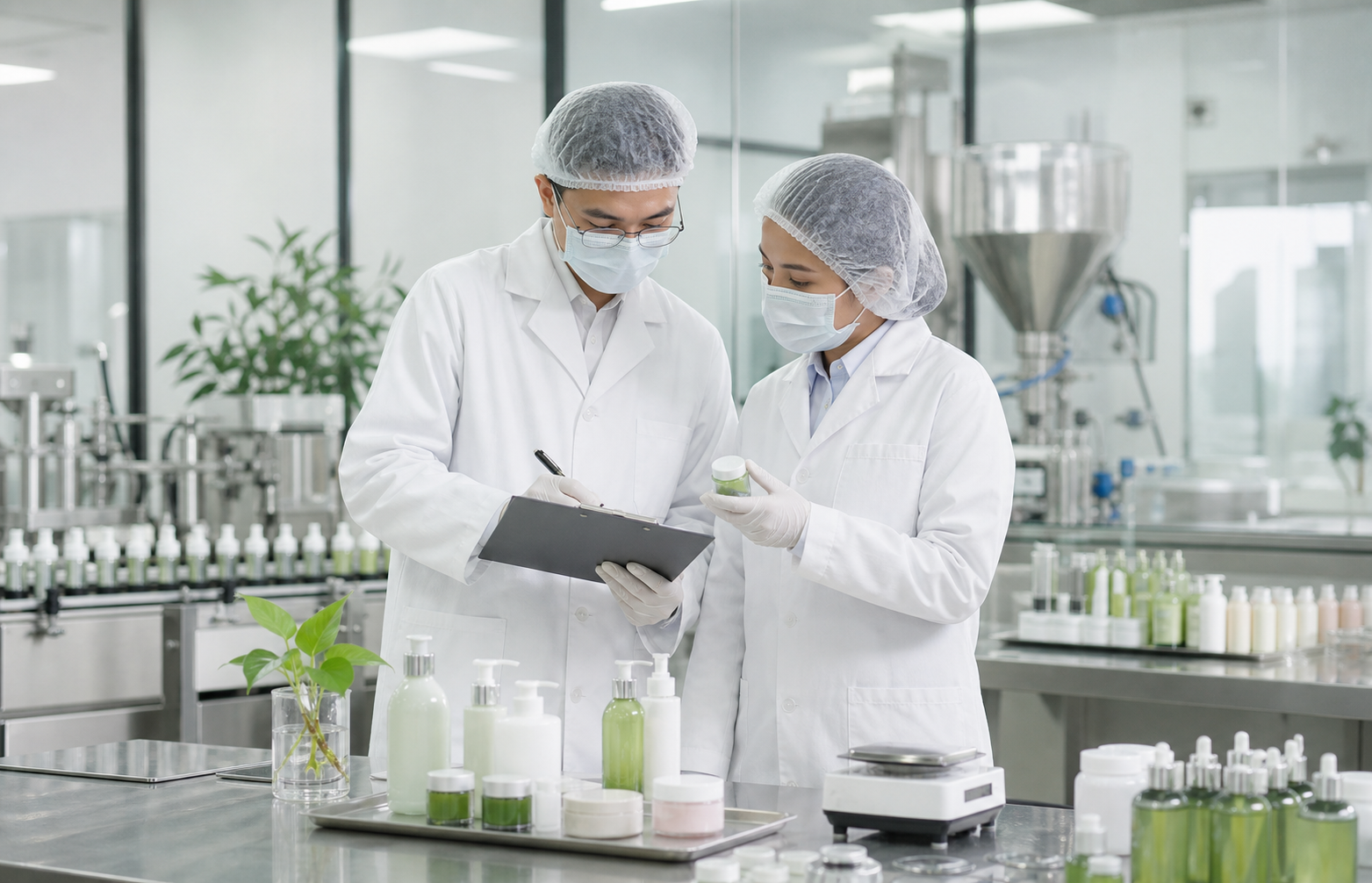
Choosing a cosmetics manufacturer in China is not simply a matter of comparing quotations. The right supplier must be able to protect product quality, communicate clearly, support the regulations of your target market, and turn a commercial brief into repeatable production.
China has a highly developed cosmetics supply chain, with strong clusters of formulation laboratories, packaging suppliers, filling facilities, and export-service companies. This gives beauty brands access to a wide range of product formats and packaging options. It also makes supplier screening essential: two companies offering a similar price may differ significantly in licensing, technical capability, traceability, testing, and export experience.
This guide explains seven practical checks to make before selecting a cosmetics manufacturer in China. It also includes a factory-audit checklist, common sourcing mistakes, and questions international buyers should ask before placing an order.
1. Verify the Manufacturer's Cosmetics Production Licence
A legitimate cosmetics factory in China must hold a valid cosmetics production licence issued by the relevant provincial authority. Ask the supplier for a complete, readable copy rather than a cropped photograph.
Confirm the following details:
- The legal company name matches the entity named in your quotation and contract.
- The licence number can be checked through an official government source.
- The licence is valid and has not expired or been suspended.
- The registered production address matches the factory you are evaluating.
- The approved production scope covers the type of product you intend to manufacture.
Production scope matters. A facility approved for certain liquid or emulsion products may not automatically be authorised for every other format. If your range includes special formats, children's cosmetics, or products with additional manufacturing requirements, ask the factory to confirm its authorised scope in writing.
You should also establish whether you are dealing directly with the licensed factory or with a trading company. A trading company can still provide a useful service, but the actual manufacturer, quality responsibilities, pricing structure, and ownership of formulas and packaging should be transparent.
2. Review GMP Systems and ISO 22716 Certification
ISO 22716 provides internationally recognised guidelines for the production, control, storage, and shipment of cosmetic products. A current ISO 22716 certificate can be a useful indicator that a factory has implemented a structured cosmetics Good Manufacturing Practice system.
When reviewing any GMP or ISO certificate, check:
- The certified legal entity and factory address.
- The certificate number, issuing body, scope, and expiry date.
- Whether the certification body can independently confirm the certificate.
- Whether the certified scope is relevant to the products you want to make.
Do not treat a certificate as proof of every production claim. Certification should be supported by visible practices: controlled material flow, written procedures, cleaning records, batch documentation, staff training, deviation handling, and a functioning quality-control laboratory.
For export projects, ask what documentation the manufacturer can support for your destination market. Requirements differ between the United States, the European Union, the United Kingdom, the Middle East, and Southeast Asia. Avoid suppliers that describe a registration or listing as government “approval” when it is not.
3. Evaluate R&D and Formulation Capability
An OEM/ODM partner should do more than mix and fill. It should be able to interpret your brief, select suitable ingredients, develop or adapt a formula, define specifications, and explain how claims will be supported.
During supplier evaluation, look for:
- An in-house laboratory and identifiable formulation team.
- Documented development and sample-approval procedures.
- Experience with the product format and target market you require.
- Access to stability, compatibility, microbiological, and packaging tests.
- A controlled formula library with version and change management.
- The ability to explain ingredient restrictions and claim limitations.
Ask technical questions that relate directly to your project. For example:
- What evidence would be needed to support a barrier-care, moisturising, anti-wrinkle, or oil-control claim?
- How will the formula be tested in the selected packaging?
- What changes would require a new stability or compatibility assessment?
- Who owns the final formula, specification, and test data?
The quality of the answers is often more informative than the number of formulas shown in a sales presentation. A capable technical team should explain what it can validate, what requires third-party testing, and what cannot be claimed without additional evidence.
4. Confirm MOQ, Packaging MOQ, and the Real Cost Structure
Minimum order quantity (MOQ) influences cash flow, unit cost, and inventory risk. However, a quoted product MOQ is only one part of the calculation.
Ask the manufacturer to separate:
- Bulk-formula MOQ.
- Filling and finished-product MOQ.
- Bottle, pump, cap, carton, label, and printed-packaging MOQs.
- Sampling, mould, printing-plate, testing, and setup charges.
- The quantity of unused packaging you may need to purchase or store.
A factory may accept a relatively small finished-product order while its packaging supplier requires a larger quantity. Clarify who owns and stores the remaining packaging, how long it will be held, and whether it can be used for a future order.
Also request lead times for each stage rather than one general estimate:
1. Brief review and quotation.
2. Formula selection or development.
3. Sample revision and approval.
4. Packaging sourcing and artwork confirmation.
5. Testing and compliance documentation.
6. Bulk production, filling, inspection, and shipment.
For a first order, the lowest unit price is usually less important than a manageable trial quantity, clearly defined specifications, and a realistic reorder plan.
5. Inspect the Quality-Control and Traceability System
A reliable cosmetics manufacturer should be able to trace raw materials, packaging components, production records, test results, and released finished goods by batch.
Ask how the factory controls each stage:
Incoming materials
- Supplier approval and material specifications.
- Certificate of Analysis review and identity checks.
- Quarantine and release status.
- Lot-number recording and storage controls.
In-process production
- Batch weighing and reconciliation.
- Mixing time, temperature, speed, and process records.
- In-process checks such as appearance, odour, pH, viscosity, and fill weight.
- Line clearance and cleaning verification.
Finished products
- Microbiological and specification testing as appropriate.
- Packaging compatibility and seal-integrity checks.
- Artwork, batch-code, and label verification.
- Retained samples and batch-release approval.
Testing should be appropriate to the formula, packaging, intended use, and destination market. Do not rely on a universal statement such as “one month at 40°C always equals a fixed shelf life.” Ask for the actual stability protocol, test points, acceptance criteria, and conclusion for your product.
During a factory visit or live video audit, request examples of a redacted batch record, raw-material traceability record, finished-product specification, and test report. A professional manufacturer should be able to explain the document flow without exposing another client's confidential information.
6. Check Regulatory Support for Your Target Market
The manufacturer can support compliance, but the brand owner, importer, distributor, or designated responsible person may still hold legal obligations. Define responsibilities before development begins.
United States
Under the Modernization of Cosmetics Regulation Act of 2022 (MoCRA), manufacturers and processors that are subject to the requirements must register their facilities with the FDA, and the responsible person must list marketed cosmetic products and provide required updates. Certain exemptions apply. FDA registration or product listing is not product approval, and the FDA does not issue cosmetic approval certificates for these submissions.
Ask whether the supplier can provide the information needed for:
- Facility registration and product listing, where applicable.
- Safety substantiation.
- Adverse-event and recordkeeping responsibilities.
- Compliant ingredient declarations and labelling.
European Union
Before a cosmetic product is placed on the EU market, it requires an EU-based Responsible Person. The Responsible Person must ensure that the required safety assessment and Product Information File are in place and that the product is notified through the Cosmetic Products Notification Portal (CPNP).
Confirm who will prepare and maintain:
- The Cosmetic Product Safety Report and PIF.
- The qualitative and quantitative formula information required for assessment.
- Supporting test reports and manufacturing information.
- CPNP notification data.
- Label text and claims review.
For any market, request an ingredient-restriction review before approving the formula. The same formula or claim may not be suitable for every country.
7. Assess Communication and Project Management
Strong manufacturing capability can still be undermined by poor communication. Before paying a deposit, assess how the supplier manages information and decisions.
Look for:
- A named account manager or project coordinator.
- Written confirmation of formula, fragrance, colour, packaging, artwork, and quantity.
- An itemised quotation that identifies optional and excluded costs.
- A realistic timeline with approval milestones.
- A structured sample-feedback process.
- Clear procedures for changes, delays, non-conformities, and rework.
The factory should ask about your target country, customer profile, positioning, preferred texture, packaging, claims, budget, launch date, and expected reorder volume. A supplier that immediately sends a generic price list without understanding the project may not be ready to manage a customised launch.
Factory Audit Checklist
Use this checklist during an on-site visit or live video audit.
Legal and commercial checks
- Production licence and legal company name verified.
- Factory address matches the licence and contract.
- Export entity and payment beneficiary are clearly identified.
- Product scope covers the proposed project.
- Formula ownership, confidentiality, and change control are defined.
Production and hygiene checks
- Personnel changing, handwashing, and controlled-entry procedures are in use.
- Raw-material, personnel, and finished-product flows are controlled.
- Mixing, transfer, filling, and cleaning equipment appears operational and maintained.
- Water-treatment and monitoring records are available where purified water is used.
- Cleaning status and line-clearance records can be demonstrated.
Quality and warehouse checks
- The QC laboratory contains operational, calibrated equipment.
- Materials are labelled with lot and status information.
- Quarantined, released, and rejected materials are separated.
- Temperature or other required storage conditions are monitored.
- Retained samples and batch records are organised and traceable.
- Pest-control and warehouse-inspection records are maintained.
Project support checks
- Sample versions and approvals are recorded.
- Packaging compatibility is considered before mass production.
- Artwork and label checks are part of the approval process.
- Export documents and destination-market requirements are discussed early.
Common Mistakes to Avoid
Choosing only by unit price
A quotation may exclude testing, packaging setup, export documentation, or excess packaging. Compare scope and risk, not just the headline price.
Failing to verify documents
Check licences and certificates independently. Confirm the legal entity, address, scope, issuer, and validity period.
Approving a sample without a written specification
A physical sample alone is not enough. Approve a formula or sample code, key specifications, packaging components, artwork, and acceptable tolerances in writing.
Ordering too much for the first launch
Use the first order to validate product-market fit and the supplier's repeatability. Scale after reviewing sales, consumer feedback, and production performance.
Leaving compliance until the end
Formula, claims, artwork, and testing requirements should be reviewed for the target market before mass production. Late regulatory changes can create costly delays.
Frequently Asked Questions
How can I verify that a Chinese cosmetics manufacturer is legitimate?
Check the factory's production licence through an official source, confirm that its legal entity and address match your contract, verify relevant certificates with the issuer, and conduct an on-site or live video audit. Start with a controlled trial order and written specifications.
What is the difference between a trading company and a factory?
A factory owns or operates the licensed production facility. A trading company coordinates sourcing and sales but may outsource manufacturing. Either model can work, provided the actual manufacturer, responsibilities, pricing, quality controls, and intellectual-property arrangements are transparent.
Can a Chinese manufacturer support US and EU compliance?
An experienced export manufacturer can provide formula details, test reports, manufacturing records, ingredient information, and documentation needed by regulatory specialists. However, legal responsibilities may remain with the responsible person, brand owner, importer, or distributor. Confirm the division of responsibilities in writing.
Should I visit the factory before ordering?
An on-site visit is valuable, especially for a high-value or technically complex project. If travel is not possible, arrange a live video audit, verify documents independently, review redacted quality records, and begin with a smaller trial order.
How long does private label cosmetics production take?
Lead time depends on formula development, sample revisions, testing, packaging availability, artwork approval, order quantity, and the destination market. A stock formula with available packaging may move relatively quickly, while a new formula with custom components can take considerably longer. Request a milestone-based timeline for your exact project.
Work With a Cosmetics Manufacturing Partner in Guangzhou
Guangdong Danlan International Biotechnology Co., Ltd. supports skincare, haircare, body-care, and other private label cosmetics projects from formulation and sampling through production and export coordination. Our team combines more than 20 years of manufacturing experience with an established formulation library and documented quality systems.
Tell us your target market, product category, estimated order quantity, packaging direction, and planned launch date. We will review the project and recommend a practical development route.
**Contact Danlan to discuss your private label cosmetics project.