
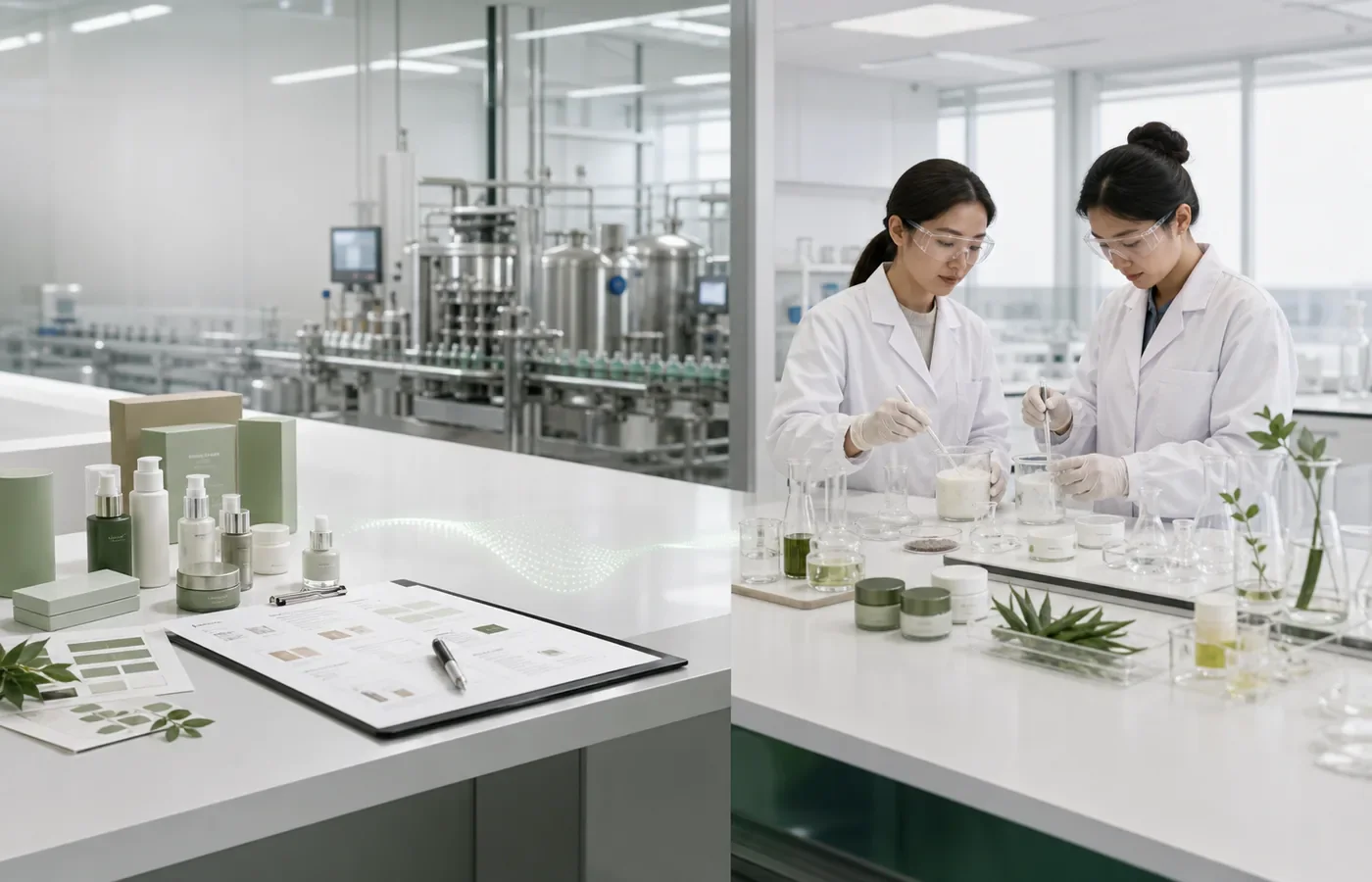
For a beauty brand, choosing between OEM and ODM cosmetics manufacturing affects far more than the formula. It influences development time, product ownership, investment, minimum order quantity, testing, packaging, and how much internal product-development expertise the brand needs.
The terms OEM and ODM are often used loosely in the cosmetics industry. Some suppliers describe any private label project as OEM, while others use ODM for every product built from an existing formula. Before requesting quotations, buyers should understand the practical difference and define which parts of the project the manufacturer is expected to manage.
This guide explains OEM vs ODM cosmetics manufacturing, compares the two models, and helps beauty brands select the most suitable route for a skincare, hair care, body care, or personal care launch.
What Is Cosmetics OEM Manufacturing?
OEM stands for Original Equipment Manufacturer. In a cosmetics OEM project, the brand normally provides the product concept, formula, technical specification, approved sample, or a detailed development brief. The manufacturer then produces the product according to the agreed requirements.
Depending on the project, the brand may control:
• The formula or ingredient direction
• Product performance and sensory targets
• Packaging structure and artwork
• Testing requirements
• Claims and label content
• Target cost and order quantity
The factory is mainly responsible for converting these instructions into a stable, repeatable manufacturing process. Its work may include raw-material sourcing, pilot production, bulk manufacturing, filling, packaging, quality control, and export coordination.
OEM is often appropriate when a brand already owns a proven formula, works with an external formulation consultant, or needs a manufacturer to reproduce a tightly defined product specification.
What Is Cosmetics ODM Manufacturing?
ODM stands for Original Design Manufacturer. In a cosmetics ODM project, the manufacturer contributes more of the product-development work. The buyer may start with a target customer, product category, price point, desired claims, texture, fragrance, or reference sample rather than a complete formula.
The ODM manufacturer may support:
• Product concept development
• Formula selection or custom formulation
• Ingredient and texture recommendations
• Sample preparation and revision
• Packaging selection and compatibility review
• Testing coordination
• Production specifications and scale-up
ODM can begin with an existing formula platform or with a more customised development route. A ready-to-use formula can reduce launch time and development cost. A customised ODM project can provide greater differentiation, but it usually requires more sampling, testing, technical review, and budget.
For new beauty brands, ODM is attractive because it provides a coordinated path from the initial brief to a finished product. However, the contract should clearly define formula ownership, exclusivity, permitted modifications, test-data access, and responsibilities for regulatory compliance.
OEM vs ODM Cosmetics: The Main Differences
Project factor
OEM cosmetics manufacturing
ODM cosmetics manufacturing
Starting point
Brand-owned formula, sample, specification, or detailed brief
Product concept, target market, performance goal, or reference product
Formula development
Usually controlled or supplied by the brand
Usually supported by the manufacturer
Brand involvement
High technical and project involvement
Manufacturer provides more development support
Development time
Can be shorter when specifications are complete
Depends on whether the formula is existing or customised
Product differentiation
High when the brand owns unique specifications
Ranges from fast private label to fully customised development
Upfront cost
May include technology transfer, validation, and production setup
May include formulation, samples, tests, and packaging development
Intellectual property
Often retained by the brand, subject to contract
Must be defined carefully in the development agreement
Best suited to
Established brands, technical teams, and proven formulations
Startups, growing brands, importers, and buyers needing a complete solution
These are typical distinctions rather than universal rules. A supplier may offer a hybrid model in which the brand selects an existing base formula and then customises active ingredients, fragrance, colour, viscosity, and packaging.
Is Private Label the Same as OEM or ODM?
Private label describes a product sold under the buyer's brand. It does not, by itself, explain who developed the formula.
A private label product may be:
• An existing manufacturer formula placed in standard packaging
• An existing formula with selected modifications
• A custom ODM formula developed for the brand
• An OEM product manufactured from a brand-owned formula
When a supplier advertises private label cosmetics, ask what can actually be changed. Formula, fragrance, colour, packaging, artwork, test program, and claims may each have different limitations, costs, and minimum order quantities.
You can review Danlan's configurable starting points on the Private Label Cosmetics page and browse current OEM and ODM product concepts.
Advantages of Cosmetics OEM Manufacturing
Greater control over the product specification
OEM gives experienced brands direct control over the formula, performance standard, packaging, and acceptance criteria. This is valuable when product consistency across suppliers or markets is essential.
Clearer ownership of brand-developed technology
When a brand brings its own formula and specifications, ownership can be easier to define. Confidentiality, technology transfer, and use restrictions should still be written into the manufacturing agreement.
Easier alignment with an established product system
OEM may suit brands that already have approved claims, testing protocols, artwork systems, component suppliers, and quality standards.
Potential for strong differentiation
A genuinely proprietary specification can create a product that is difficult for competitors to copy. The trade-off is greater internal responsibility for development decisions and compliance.
Advantages of Cosmetics ODM Manufacturing
Faster access to formulation expertise
ODM manufacturers can offer formula libraries, product-development teams, sample procedures, and knowledge of common packaging systems. This can reduce the number of suppliers a brand must coordinate.
Lower barrier for new product launches
A brand does not need to employ a full in-house R&D team to begin. A clear commercial brief can be translated into practical formula and packaging options.
More efficient development workflow
Formula, packaging, compatibility, production, and quality-control decisions can be managed within one project. This reduces communication gaps between unrelated laboratories, component suppliers, and filling factories.
Flexible levels of customisation
Brands can choose a proven formula for speed or invest in deeper formulation work for differentiation. This makes ODM useful for both first launches and range extensions.
Risks to Manage in Both Models
Neither model removes the need for due diligence. Buyers should manage the following issues before paying a deposit.
Formula ownership and exclusivity
Confirm whether the formula is manufacturer-owned, brand-owned, shared, or licensed. Ask whether identical or similar formulas can be sold to other brands and whether exclusivity is available.
Minimum order quantities
Product MOQ and packaging MOQ may be different. Pumps, bottles, printed cartons, labels, and custom moulds can each carry separate minimums. Request an itemised quotation.
Sample and change control
Approve a sample code, formula version, colour, fragrance, packaging components, artwork, and written specification. Define how later changes will be reviewed and documented.
Testing and claims
Testing should reflect the formula, packaging, intended use, claims, and destination market. Ask which tests are included, which require a third party, and who owns the resulting reports.
Regulatory responsibility
The manufacturer can provide technical documents and manufacturing information, but the brand owner, importer, distributor, or designated responsible person may still hold legal obligations in the destination market. Define the division of work in writing.
How to Choose Between OEM and ODM
Use the following questions to select the right route.
Choose OEM when:
• You already own a complete and validated formula
• Your team can issue detailed specifications and test requirements
• You require strict control over ingredients and manufacturing parameters
• You have an established packaging and regulatory system
• Product intellectual property is central to your strategy
Choose ODM when:
• You have a product idea but not a finished formula
• You need support with samples, packaging, testing, and scale-up
• You want to launch faster using a proven formula platform
• You need one manufacturing partner to coordinate several development stages
• Your team is focused on branding, sales, distribution, and market development
Choose a hybrid route when:
• You want to begin with an existing base and customise selected features
• You own part of the technology but need the factory to complete development
• You want to test the market before funding a fully proprietary formula
• You need standard packaging for the first order and custom components later
Questions to Ask a Cosmetics OEM or ODM Manufacturer
Before confirming a project, ask:
• Are you the licensed manufacturer or a trading company?
• Which product formats are included in your production scope?
• Is the proposed formula existing, modified, or newly developed?
• Who owns the formula and development data?
• Which tests are included in the quotation?
• What are the formula, filling, bottle, pump, label, and carton MOQs?
• How many sample revisions are included?
• What information do you need about the target market?
• How are formula and packaging changes controlled?
• What happens to unused printed packaging?
• Which documents are supplied with each production batch?
• How are complaints, deviations, and rework handled?
Clear answers make it easier to compare suppliers on project scope rather than unit price alone.
A Practical OEM/ODM Project Workflow
A well-managed project usually follows these stages:
• Commercial brief: category, target consumer, market, price, claims, quantity, and launch date
• Route selection: OEM, existing ODM formula, modified formula, or custom formulation
• Quotation: formula, packaging, testing, setup charges, MOQ, and lead time
• Sampling: texture, fragrance, colour, performance, and packaging review
• Technical approval: formula code, specification, test plan, and approved sample
• Artwork and packaging: dielines, label text, print proofs, and component confirmation
• Production: raw-material approval, bulk manufacturing, filling, and packing
• Quality release: batch testing, inspection, documentation, and shipment approval
Each approval should be documented. Verbal confirmation is not enough for a repeatable international supply project.
Work With a Cosmetics OEM and ODM Manufacturer in China
Guangdong Danlan International Biotechnology Co., Ltd. supports private label skincare, hair care, body care, and personal care projects. Buyers can begin with a proven product platform, request selected customisation, or discuss a more tailored formulation route.
Share your target market, category, positioning, expected quantity, packaging direction, and launch date. The team can then recommend whether OEM, ODM, or a hybrid development route is more practical.
https://danlanbeauty.com/Contact Danlan to discuss your cosmetics manufacturing project.