
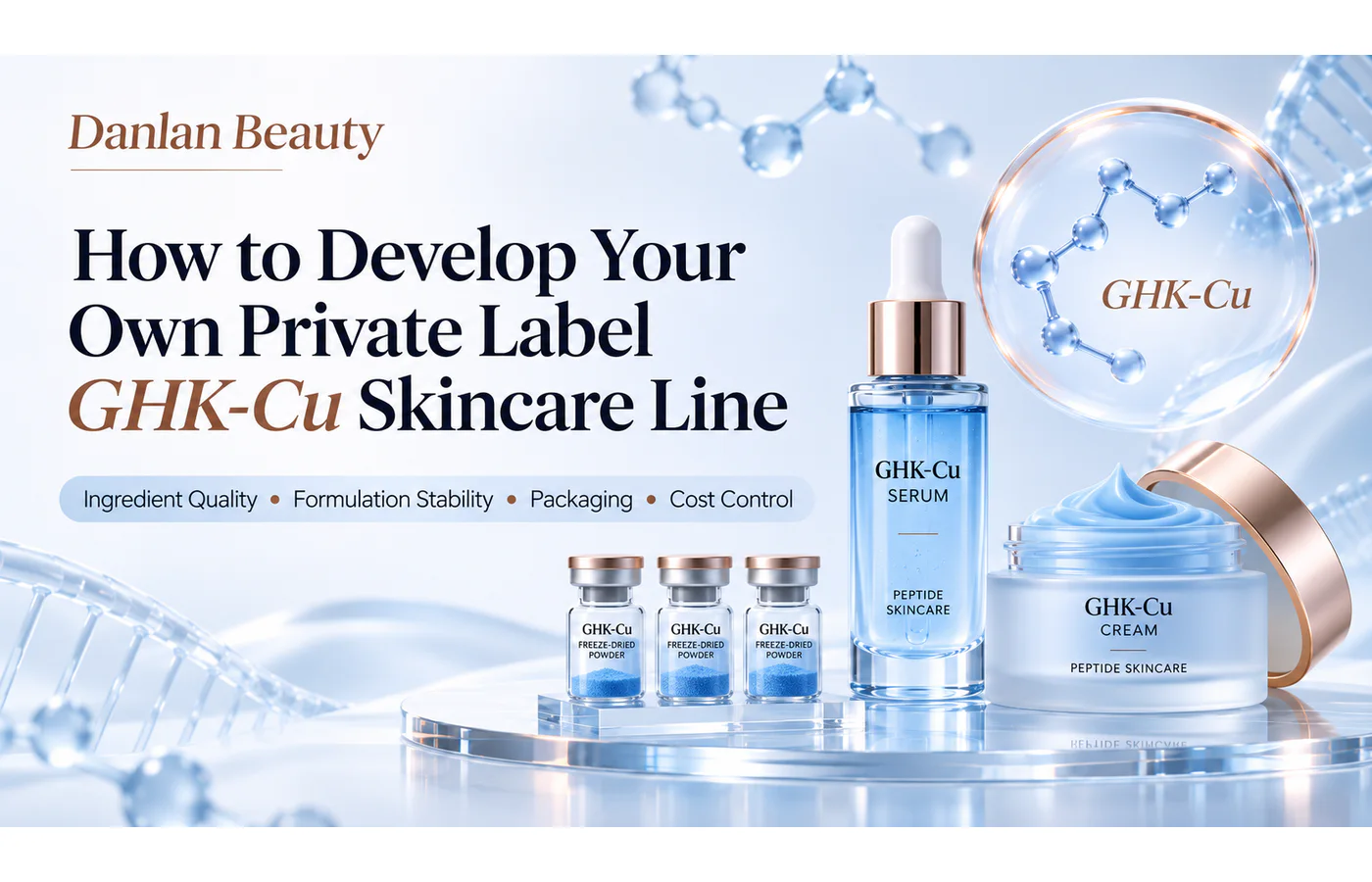
In recent years, peptide-based skincare products have gained increasing attention, particularly for their potential benefits in anti-wrinkle and anti-aging formulations. Small-molecule peptides offer promising skincare applications, although their skin penetration depends on their molecular structure and formulation system.
Driven by social media and growing market interest, GHK-Cu (Copper Tripeptide-1) has become an important product development focus for many skincare brands.
However, developing a private label GHK-Cu skincare line requires careful consideration of several factors, including ingredient quality, active ingredient concentration, sales channels, formulation stability, packaging, and manufacturing costs.
High-purity GHK-Cu is a relatively expensive anti-aging ingredient. As a professional cosmetic OEM/ODM manufacturer, Danlan Beauty addresses the following key questions from a practical formulation and manufacturing perspective.
1. What Types of GHK-Cu Skincare Products Can You Develop?
GHK-Cu can be incorporated into a wide range of skincare and personal care products, including:
GHK-Cu Eye Cream
GHK-Cu Freeze-Dried Powder
GHK-Cu Facial Mask
GHK-Cu Scalp Serum
GHK-Cu Shampoo
For emerging skincare brands, identifying industry trends and market opportunities is important. However, it is equally important to select suitable products based on your existing sales channels, target consumers, purchasing power, and pricing strategy rather than simply following market trends.
2. How to Determine Product Positioning and GHK-Cu Concentration?
GHK-Cu raw materials from different suppliers may vary significantly in purity, actual active ingredient content, and purchasing cost.
Brands should understand that the percentage of GHK-Cu raw material added to a formulation is not necessarily equal to the actual concentration of pure GHK-Cu in the finished product.
For example, if a formulation contains 1% of a GHK-Cu raw material with an active ingredient content of 10%, the theoretical concentration of pure GHK-Cu in the finished product is only 0.1%.
High-purity GHK-Cu is a relatively expensive active ingredient. For premium skincare products primarily positioned around anti-wrinkle and anti-aging benefits, using GHK-Cu raw materials with a purity of 99% or higher at an inclusion level of approximately 0.5% can be considered as a formulation development starting point. However, this will also significantly increase raw material costs.
It is important to note that 0.5% is not a universally established minimum effective concentration, and a higher concentration does not necessarily deliver better results.
The appropriate concentration should be determined based on product positioning, safety, efficacy testing, ingredient combinations, and formulation stability.
3. What Ingredients Can Be Combined with GHK-Cu?
To create differentiated skincare products and improve market competitiveness, brands can consider the following formulation concepts:
GHK-Cu + Hyaluronic Acid
Suitable for moisturizing, anti-wrinkle, and early anti-aging skincare products, addressing skin dryness while targeting the appearance of fine lines.
GHK-Cu + PDRN + Ceramides
Suitable for premium skincare formulations targeting the appearance of wrinkles, signs of aging, and skin barrier support.
GHK-Cu + Glycyrrhiza Glabra Root Extract + Panthenol
Suitable for multifunctional skincare products focused on skin brightening, improving the appearance of dullness, long-lasting hydration, and skin barrier support.
GHK-Cu + Multi-Peptides + Hydroxypropyl Tetrahydropyrantriol
Suitable for premium skincare products targeting fine lines, skin firmness, and multiple visible signs of aging.
However, developing an effective formulation is not simply a matter of combining popular active ingredients. Professional formulation development and testing are essential to evaluate ingredient compatibility, product stability, and the actual performance of the finished product.
4. How to Ensure the Stability of GHK-Cu Skincare Products?
GHK-Cu is a complex formed by a tripeptide bound to a divalent copper ion. Its activity and stability can be affected by environmental conditions and interactions with other ingredients.
During formulation development, particular attention should be paid to the following six factors:
① Proteases
GHK-Cu is a small oligopeptide. Certain proteolytic enzymes may break down its peptide structure and reduce its activity. Therefore, ingredients with proteolytic properties should be used cautiously in GHK-Cu formulations.
② Extremely Low or High pH Levels
Ingredients such as salicylic acid, lactic acid, and azelaic acid, as well as highly alkaline soap-based formulations, require careful pH management.
An unsuitable pH environment may affect the coordination structure and stability of GHK-Cu, potentially resulting in discoloration or reduced activity.
③ Chelating and Complexing Agents
Ingredients with strong metal-chelating properties, such as EDTA, may compete with GHK for copper ions, potentially affecting the structure and activity of GHK-Cu.
④ Anionic Polymers
Ingredients such as carbomer and polyglutamic acid may interact with copper ions, potentially affecting formulation stability, viscosity, and GHK-Cu activity.
Compatibility testing is therefore important when incorporating these ingredients into a GHK-Cu formulation.
⑤ Reducing Agents and Reactive Metals
High concentrations of pure vitamin C and other strongly reducing ingredients may alter the oxidation state of copper ions, potentially affecting GHK-Cu stability.
The compatibility of vitamin C derivatives, arbutin, astaxanthin, and other ingredients should also be evaluated according to their specific properties and the overall formulation system.
During manufacturing, contamination from reactive metals and metallic impurities should also be avoided.
⑥ Niacinamide
When combining niacinamide with GHK-Cu, formulators should consider potential nicotinic acid impurities, coordination interactions, and the overall formulation environment.
Compatibility and stability testing should be conducted rather than assuming that these two ingredients are always compatible or incompatible.
Overall, the key to developing a stable GHK-Cu formulation is to preserve its peptide structure and copper coordination state.
Manufacturing temperature, light exposure, raw material storage conditions, and packaging materials should also be carefully considered. Finished product stability testing should be conducted before mass production.
For acidic, strongly reducing, or enzyme-based skincare products whose compatibility has not been established, consumers may be advised to use them separately from GHK-Cu products in their morning and evening skincare routines.
Additionally, the intensity of a GHK-Cu product's blue color does not necessarily indicate its actual concentration or quality. Brands should pay greater attention to raw material purity, actual active ingredient content, and relevant testing data.
5. How to Choose Suitable Packaging for GHK-Cu Products?
Packaging not only influences brand image but also affects product stability and the overall consumer experience.
For emerging brands, standard packaging with customized labels, screen printing, and outer boxes can help establish brand identity while reducing initial investment.
For mid-range and premium brands, frosted glass bottles, airless pump bottles, electroplated finishes, and coordinated packaging designs can enhance product presentation and brand recognition.
Given the storage requirements of GHK-Cu formulations, brands may also consider light-protective packaging and airless dispensing systems that help minimize exposure to air.
The final packaging solution should be determined based on product characteristics, light protection requirements, packaging compatibility, and the available budget.
6. How to Control the Development Costs of a GHK-Cu Skincare Line?
The manufacturing cost of GHK-Cu skincare products mainly depends on raw material quality, actual GHK-Cu concentration, additional active ingredients, packaging specifications, and order quantities.
For emerging brands with limited budgets, we do not recommend launching too many products at once. Starting with one to three core products and using established or optimized formulations can help reduce development costs and inventory risks.
Once these products gain market acceptance, the brand can gradually expand its GHK-Cu product line.
When planning product development, brands should consider not only the purchasing power of their target consumers, sales channel characteristics, and expected retail prices, but also product testing, regulatory compliance, packaging design, and international shipping costs.
For brands and distributors targeting the mass market, where purchasing costs are particularly important, a lower concentration of GHK-Cu can be combined with essential skincare ingredients such as hyaluronic acid, glycerin, and panthenol.
This approach allows brands to deliver everyday moisturizing and nourishing benefits while taking advantage of growing consumer interest in GHK-Cu and developing competitively priced products.
For brands targeting mid-range and premium markets, higher-purity GHK-Cu, appropriately increased active concentrations, and other high-value active ingredients can be considered to develop differentiated, performance-oriented skincare products.
A lower GHK-Cu concentration does not necessarily mean lower overall product quality.
The key is to allocate the available budget effectively across active ingredients, formulation development, packaging, and marketing according to the brand's market positioning, sales channels, and consumer needs, while ensuring that product claims accurately reflect its demonstrated benefits.
Not every GHK-Cu product needs to be positioned as a premium skincare product. Developing products that suit your sales channels, meet consumer expectations, and offer reasonable profit margins is often more beneficial for long-term business growth.
7. How to Choose a Reliable GHK-Cu OEM/ODM Manufacturer?
When selecting a GHK-Cu skincare manufacturer, brands should look beyond product quotations and consider the following factors:
Professional formulation development and laboratory sampling capabilities
GHK-Cu raw material purity and actual active ingredient content
Manufacturing qualifications, including GMP and ISO 22716
Product stability testing and quality control capabilities
Packaging design and customization services
Regulatory documentation support for target markets
Mass production and long-term supply capabilities
A reliable cosmetic manufacturer should be able to provide tailored product development solutions based on your brand positioning, sales channels, product requirements, and budget, while clearly communicating GHK-Cu raw material specifications and formulation inclusion levels.
For brands seeking sustainable business growth, consistent product quality, reasonable manufacturing costs, and reliable long-term supply are often more important than short-term purchasing savings.
Conclusion
Successfully developing a private label GHK-Cu skincare line is not about simply pursuing higher concentrations, luxury packaging, or trending ingredients. It is about achieving the right balance between ingredient quality, scientific formulation, product stability, market positioning, sales channels, and manufacturing costs.
Whether you are launching a new skincare brand, operating a cosmetics distribution business, or expanding an established product line, your development strategy should reflect your market demand, sales advantages, and available budget.
For mass-market products, brands can capitalize on the growing popularity of GHK-Cu while maintaining essential skincare benefits and competitive pricing. For mid-range and premium markets, high-quality ingredients, differentiated ingredient combinations, and professional formulation development can help create products with greater added value.
As a professional cosmetic OEM/ODM manufacturer based in China, Danlan Beauty has its own formulation R&D team and manufacturing facilities. We provide customized formulation development, sample preparation, packaging customization, and mass production services for GHK-Cu facial serums, creams, eye creams, freeze-dried powders, scalp care products, and other GHK-Cu skincare products.
We offer tailored product development solutions based on your brand positioning, sales channels, target market, and budget.
If you are planning to launch your own GHK-Cu skincare brand, contact Danlan Beauty to develop a distinctive and competitive product line tailored to your market.