
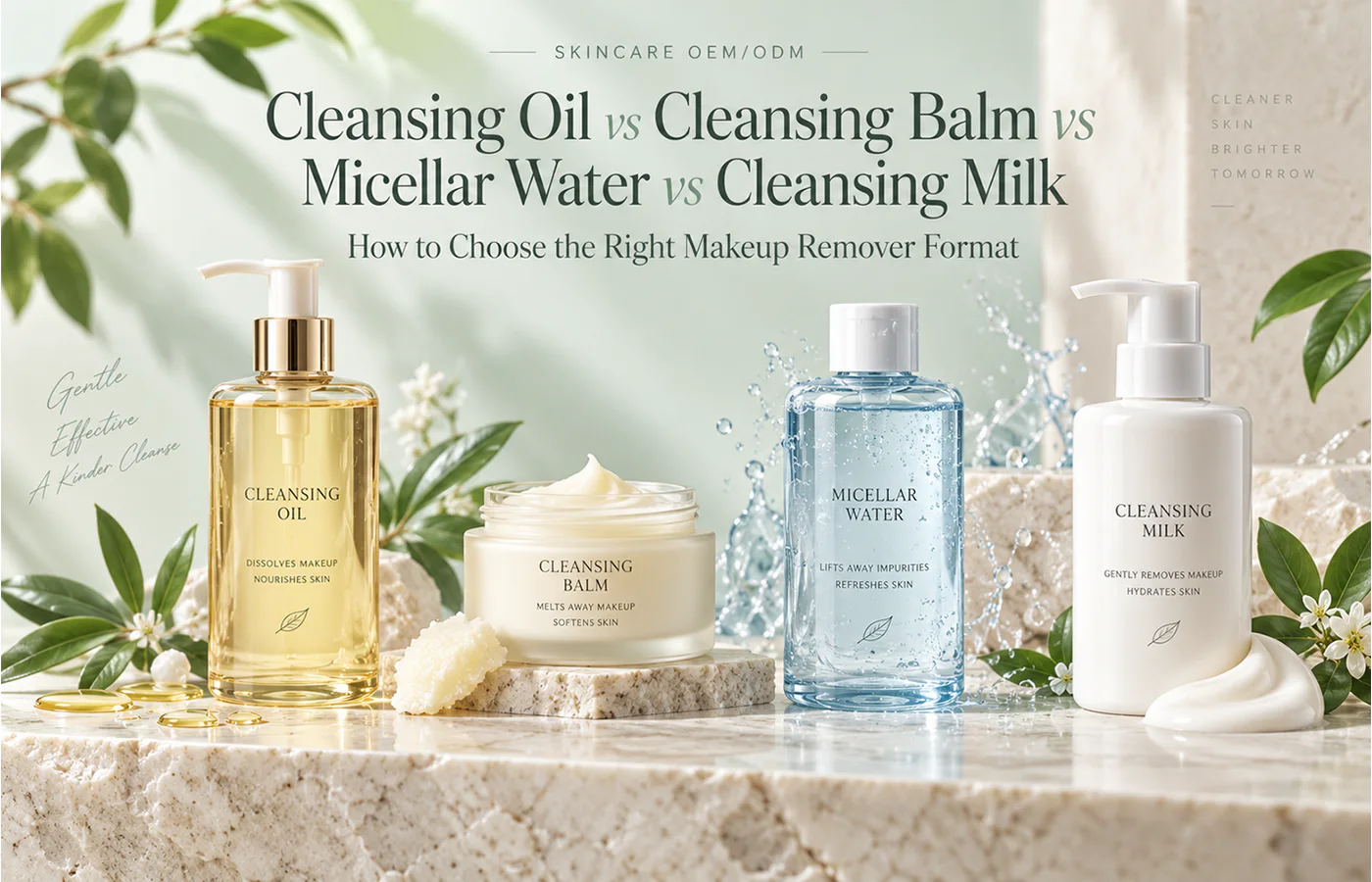
Cleansing Oil vs Cleansing Balm vs Micellar Water vs Cleansing Milk: Which Makeup Remover Is Best?
Choosing the right makeup remover is not simply about finding the product that removes makeup the fastest.
For consumers, a good makeup remover should balance cleansing performance, comfort, rinsability and skin feel. For beauty brands developing a new cleansing product, the decision is even more complex because formula structure, target consumers, packaging, climate stability and product positioning all need to be considered.
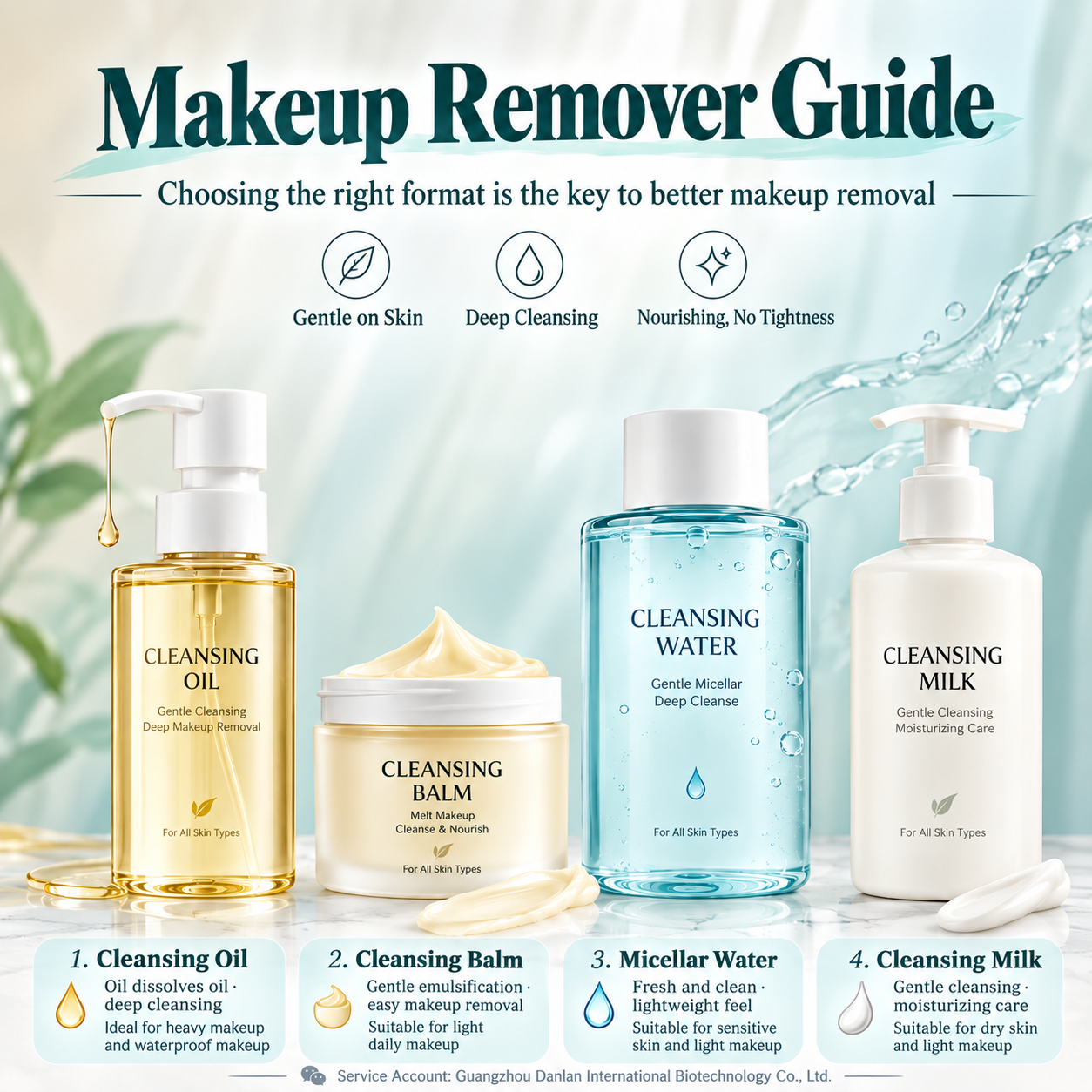
The four most common makeup remover formats are:
Cleansing Oil、Cleansing Balm、Cleansing Milk、Micellar Water
Each format works differently and serves a different consumer need.
For brands planning to develop a private label makeup remover, understanding these differences can help determine which format is most suitable before sampling and production begin.
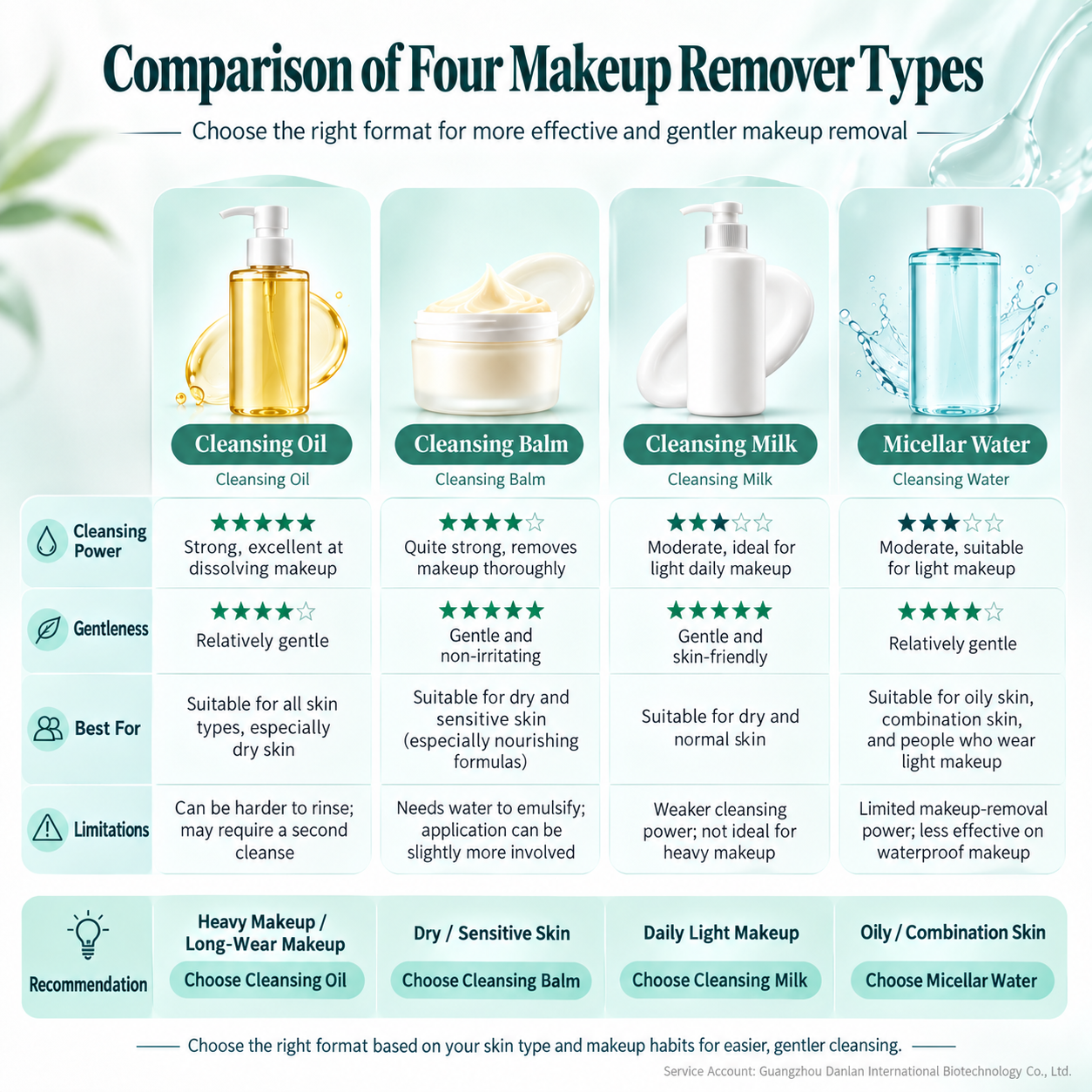
| Makeup Remover Type | Cleansing Performance | Skin Feel | Best For | Main Development Focus |
|---|---|---|---|---|
| Cleansing Oil | High | Silky to nourishing | Waterproof makeup, sunscreen, full makeup | Oil system and emulsification |
| Cleansing Balm | High | Rich and melting | Medium to heavy makeup | Melting texture and temperature stability |
| Cleansing Milk | Medium | Soft and creamy | Light makeup, dry or sensitive-skin positioning | Mild cleansing and skin feel |
| Micellar Water | Light to medium | Fresh and lightweight | Light makeup and quick cleansing | Surfactant mildness and eye comfort |
There is no single makeup remover format that is best for every customer.
The right choice depends on the brand's target audience, makeup habits, desired texture and market positioning.
1. Cleansing Oil: Best for Strong Makeup Removal
How Does Cleansing Oil Work?
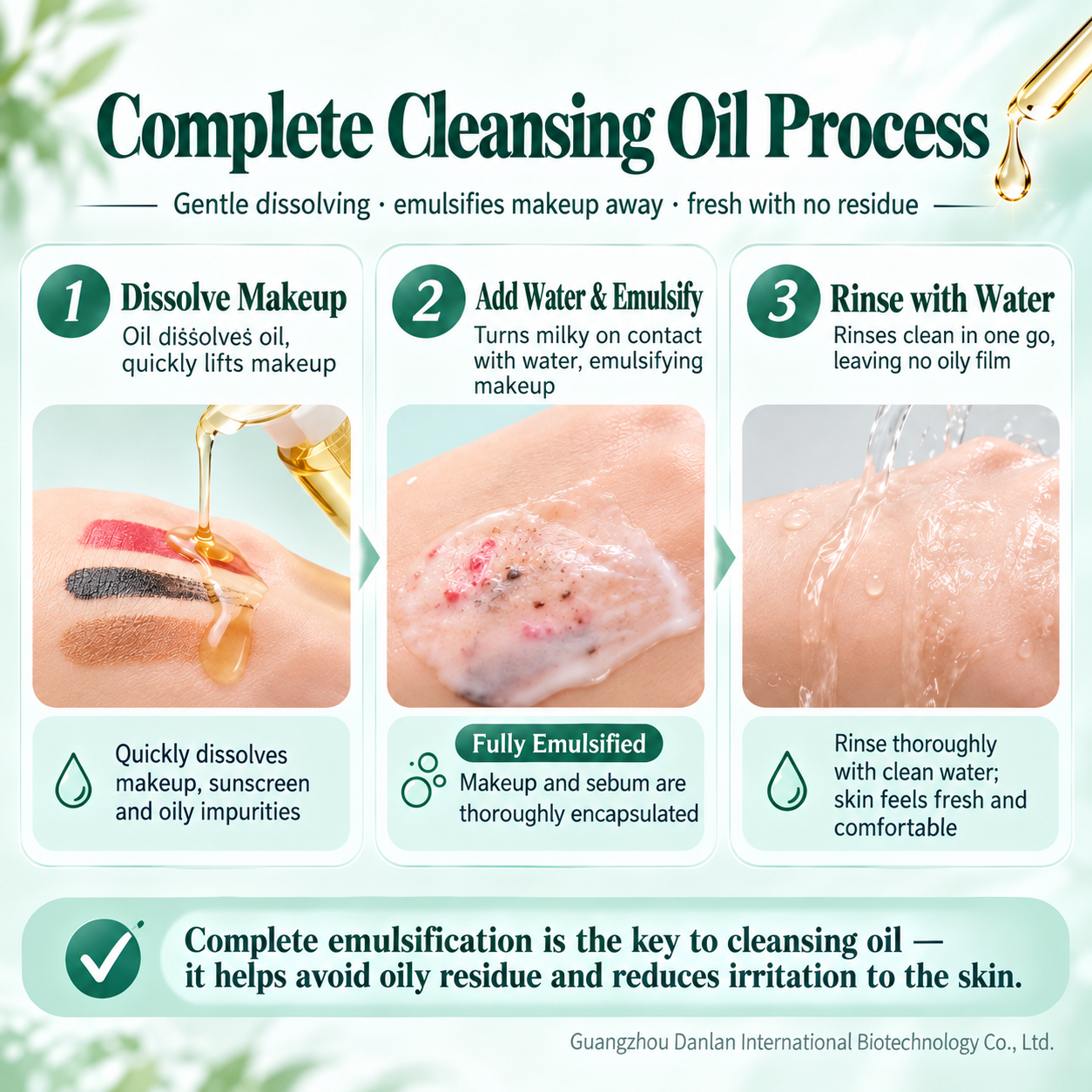
Cleansing oil mainly works by using oil-compatible ingredients to dissolve oily makeup components, sunscreen films and pigments.
During use, the oil spreads over the skin and helps loosen makeup. Once water is added, the emulsifying system disperses the oil phase into water so that makeup and excess oil can be rinsed away.
This means that good cleansing oil performance depends on more than just how quickly it dissolves makeup.
A well-developed private label cleansing oil should balance:
- Makeup dissolving performance、Emulsification speed、Rinsability、After-feel、Eye-area comfort
- Residue level
Advantages of Cleansing Oil
Cleansing oils are particularly suitable for consumers who regularly use:
- Foundation、Waterproof sunscreen、Long-wear makeup、Waterproof eyeliner、Heavy or layered makeup
They also provide good slip during massage, which can reduce excessive rubbing compared with some wipe-off cleansing methods.
What Should Brands Consider When Developing Cleansing Oil?
Oil System
Different esters, emollients and plant oils can create very different sensory profiles.
The oil system influences:
- Spreadability、Thickness、Makeup dissolving speed、Rinsing feel、Post-cleansing softness
Emulsification System
Emulsification is one of the most important parts of cleansing oil development.
The goal is to achieve fast and even emulsification when water is added, while avoiding an excessively heavy or greasy film after rinsing.
Consumers sometimes describe a cleansing oil as “too greasy” or “difficult to rinse.” In many cases, this is not simply because the product contains oil. The overall oil-to-emulsifier balance and formula structure are equally important.
For brands looking for a cleansing oil manufacturer, sample evaluation should therefore include both makeup-removal testing and rinse-off performance.
2. Cleansing Balm: A Premium Format with Strong Sensory Appeal
What Is the Difference Between Cleansing Balm and Cleansing Oil?
Cleansing balm and cleansing oil use similar cleansing principles.
The main difference is texture.
A cleansing balm is usually solid or semi-solid at room temperature. During application, body heat and rubbing help the balm melt into an oil-like texture.
The melted product then dissolves makeup before emulsifying and rinsing away with water.
This transformation from balm to oil is one reason cleansing balms are popular in premium skincare routines.
Advantages of Cleansing Balm
A cleansing balm can offer:
- Strong makeup-removal performance、A rich massage experience、Easy control of product dosage
- Premium jar packaging、A distinctive balm-to-oil sensory transformation
This makes private label cleansing balm a strong option for brands targeting consumers who value both performance and product experience.
What Is the Biggest Formulation Challenge with Cleansing Balm?
One of the biggest challenges is temperature stability.
The balm needs to maintain an appropriate texture across different temperatures.
If the structural system is not properly balanced, brands may experience problems such as:
- Balm becoming too soft in hot weather、Oil separation during transportation
- Balm becoming too hard in cold conditions、Difficulty scooping the product
- Grainy texture、Inconsistent melting performance
For this reason, cleansing balm development should not focus only on makeup removal.
Brands should also evaluate:
- High-temperature stability、Low-temperature stability、Transportation conditions
- Packaging compatibility、Melting speed、Rinsability
This is especially important for products sold across different climates.
3. Cleansing Milk: A Good Choice for Mild Daily Cleansing
Cleansing milk usually combines emollients, emulsifiers and mild cleansing agents in a creamy lotion-like texture.
Compared with cleansing oil and cleansing balm, cleansing milk normally focuses less on maximum waterproof-makeup removal and more on comfort and mild daily cleansing.
What Are the Advantages of Cleansing Milk?
Cleansing milk can be positioned around:
- Gentle cleansing、Soft skin feel、Low-friction application、Dry-skin routines、Sensitive-skin positioning
- Light everyday makeup
It can be particularly suitable for consumers who dislike heavy oil textures.
A brand developing a cleansing milk should first decide whether its main goal is:
gentle everyday makeup removal
or
stronger makeup-cleansing performance.
These two positioning strategies may require different oil ratios, surfactant systems and sensory profiles.
For light makeup, sunscreen and daily cleansing routines, a well-designed cleansing milk can offer an attractive balance between cleansing performance and comfort.
4. Micellar Water: Fresh, Convenient and Easy to Use
How Does Micellar Water Remove Makeup?
Micellar water is primarily water-based and uses mild surfactant systems to help lift makeup, sebum and surface impurities.
Consumers normally apply it with a cotton pad.
Its light texture and convenient application make micellar water one of the most accessible makeup remover formats for everyday use.
Advantages of Micellar Water
Micellar water is often selected for:
- Light makeup、Daily sunscreen、Quick cleansing、Fresh skin feel、Younger consumers、
- Large-volume daily-use products
For brands planning a micellar water private label product, cleansing performance is only one part of formula evaluation.
Two additional factors are especially important.
Surfactant Mildness
Increasing cleansing power does not automatically improve the product.
An overly aggressive surfactant system may negatively affect eye comfort and overall user experience.
The formula should therefore balance:
- Makeup removal、Surfactant level、Mildness、Eye-area comfort、Skin feel
Cotton-Pad Friction
Micellar water is normally used with cotton pads.
The issue is not necessarily the cotton pad itself, but repeated or aggressive rubbing.
Product directions can therefore encourage users to saturate the cotton pad, hold it gently against the makeup for a few seconds and wipe softly instead of repeatedly rubbing the same area.
Clear usage instructions can significantly improve the consumer experience.
Which Makeup Remover Should a Beauty Brand Develop First?
For a new beauty brand, it is not always necessary to launch multiple makeup remover formats at the same time.
The better approach is usually to choose one clear consumer need and develop a hero product around it.
For Everyday Mass-Market Cleansing
Consider:
- Micellar Water、Cleansing Milk
These formats are suitable for:
- Light makeup、Sunscreen、Everyday cleansing、Fresh or gentle positioning、Broad consumer groups
For Stronger or More Premium Makeup Removal
Consider:
- Cleansing Oil、Cleansing Balm
These formats are more suitable for:
- Regular makeup users、Waterproof makeup、Long-wear sunscreen
- Premium skincare positioning、Consumers who enjoy a massage-based cleansing routine
Small MOQ Makeup Remover Manufacturing for Startup Brands
Startup beauty brands do not necessarily need to begin with a fully customized formula and several SKUs.
A lower-risk route is to use:
- Proven existing formulas、Stock packaging、Simple label customization
- A limited number of SKUs、Small initial production quantities
Using small MOQ cosmetic manufacturing allows a startup brand to test market demand before investing heavily in inventory, custom molds or extensive formula development.
This strategy can be particularly useful for startup beauty brands launching their first skincare or cleansing product.
Once sales and consumer feedback become more stable, the brand can gradually move toward:
- Customized texture、Customized fragrance、Exclusive ingredients、Unique packaging
- Larger production quantities、Fully customized formulas
This creates a more flexible path from market testing to long-term product development.
Can an Eye & Lip Makeup Remover Use the Same Formula as a Full-Face Remover?
Not necessarily.
Eye and lip areas have specific performance requirements.
A dedicated eye and lip makeup remover may need to effectively remove:
- Waterproof mascara、Long-wear eyeliner、Lip stain、Long-lasting lipstick、Highly pigmented makeup
At the same time, developers need to pay close attention to:
- Eye-area comfort、Blurred-vision sensation、Oily residue、Removal speed、Sensory feel
For this reason, brands should not automatically assume that a standard full-face makeup remover formula can be reused without adjustment.
Dedicated testing is recommended when developing an eye and lip cleansing product.
4 Common Mistakes in Makeup Remover OEM Development
1. Focusing Only on How Fast the Product Removes Makeup
Fast makeup removal is useful, but it is not the only performance indicator.
A cleansing oil or balm that removes foundation quickly but leaves an unpleasant heavy film may still receive poor consumer feedback.
Brands should evaluate both cleansing performance and the post-rinse experience.
2. Increasing Cleansing Strength at the Expense of Comfort
Stronger surfactants or higher surfactant levels do not automatically create a better makeup remover.
The real formulation challenge is achieving the required cleansing performance while maintaining a comfortable user experience.
3. Ignoring Temperature Stability in Cleansing Balm
Cleansing balm needs special attention during stability evaluation.
A formula that performs well at normal room temperature may behave differently during summer transport, winter storage or export to tropical markets.
Temperature testing should therefore be part of product development.
4. Adding Too Many Marketing Ingredients While Ignoring the Cleansing System
Ingredients such as ceramides, panthenol, vitamin E and botanical extracts can support product storytelling.
However, the core of a makeup remover is still its cleansing and emulsification system.
Before adding multiple concept ingredients, brands should first ensure that the product has:
- Reliable cleansing performance
- Good rinsability
- Comfortable skin feel
- Suitable stability
- Appropriate packaging compatibility
A strong base formula is more important than simply having a long ingredient story.
What Should Brands Ask a Makeup Remover OEM Manufacturer?
Before developing a makeup remover, brands should clarify several key points with their private label skincare manufacturer.
1. Which Format Do You Want?
Cleansing oil, cleansing balm, cleansing milk or micellar water?
2. What Makeup Should It Remove?
Light everyday makeup, waterproof makeup or both?
3. Will It Be Used Around the Eyes and Lips?
This can affect formula evaluation and testing requirements.
4. What Skin Feel Do You Want?
Fresh, silky, lightweight, nourishing or rich?
5. Who Is the Target Consumer?
Mass market, sensitive-skin positioning, premium skincare users or professional makeup users?
6. Which Country Will the Product Be Sold In?
Climate, regulatory requirements and consumer preferences may differ by market.
7. Do You Need Fragrance Customization?
Fragrance level and type can be adjusted depending on brand positioning.
8. Do You Already Have Packaging?
If not, stock packaging can help reduce development time and packaging MOQ.
9. Do You Need an Existing Formula or a New Custom Formula?
For a new brand testing the market, ready-made cosmetic formulas can often reduce development time and initial cost.
10. What Is Your Target Order Quantity?
MOQ influences packaging options, printing method and customization level.
Stock Packaging vs Fully Customized Packaging
Packaging is another major factor in makeup remover development.
For small-batch projects, using stock bottles or jars together with simple cosmetic packaging customization can reduce both packaging MOQ and upfront investment.
Typical low-MOQ options may include:
- Stock bottles、Stock jars、Standard pumps、Standard caps、Printed labels、Simple printed boxes
When volume increases, brands can gradually consider:
- Custom colors、Silk-screen printing、Hot stamping、Custom bottle molds、Premium gift boxes
- Fully customized packaging systems
This staged approach is often more practical for startup brands.
Danlan Beauty Makeup Remover OEM/ODM Services
Danlan Beauty provides makeup remover OEM/ODM and private label manufacturing services for different brand positioning and market needs.
Available product formats can include:
- Cleansing Oil、Cleansing Balm、Cleansing Milk、Micellar Water、Eye & Lip Makeup Remover
Depending on the project, formula characteristics such as the following can be adjusted:
- Makeup removal performance、Emulsification speed、Rinsability、Texture
- Skin feel、Fragrance、Viscosity、Packaging format
For startup brands and market-testing projects, existing formulas and stock packaging can also provide a more flexible route for small-batch production.
As a cosmetic OEM/ODM manufacturer, Danlan Beauty supports brands from formula selection and sampling to packaging, filling and finished-product manufacturing.
Frequently Asked Questions
Does Cleansing Oil Always Cause Clogged Pores?
No.
Whether a cleansing oil is suitable for a particular consumer depends on the entire formulation, including the oil system, emulsification system, rinsability, usage method and individual skin condition.
It is not accurate to judge every cleansing oil based only on the fact that it contains oils.
Is Micellar Water Always Gentler Than Cleansing Oil?
No.
Product format alone does not determine mildness.
Micellar water depends heavily on its surfactant system and how it is used, while cleansing oil depends on the oil system, emulsifiers and rinse-off performance.
The finished formula should be evaluated as a complete system.
Which Makeup Remover Is Suitable for Sensitive-Skin Positioning?
Brands targeting sensitive-skin consumers may consider mild cleansing milk, carefully formulated micellar water or low-irritation cleansing oil systems.
The final decision should be based on the actual formula and appropriate product testing rather than the product format alone.
Which Makeup Remover Is Better for Waterproof Sunscreen?
Oil-based systems such as cleansing oil and cleansing balm are commonly used for waterproof sunscreen and long-wear makeup because they can effectively interact with oil-soluble and film-forming makeup components.
Should a Startup Brand Choose an Existing Formula or a Custom Formula?
For early-stage market testing, an existing mature formula can often reduce development time, formulation cost and production complexity.
Once the product has established stable sales, the brand can move toward deeper formula customization.
What Is the Best Makeup Remover for a New Beauty Brand?
There is no single best option.
For light makeup and broad daily-use positioning, micellar water or cleansing milk can be practical choices.
For stronger makeup removal and premium positioning, cleansing oil or cleansing balm may be more suitable.
The final decision should consider the target consumer, price range, expected MOQ, packaging and product positioning.
Start Your Private Label Makeup Remover Project
If you are developing a cleansing oil, cleansing balm, cleansing milk, micellar water or eye and lip makeup remover, the first step is to define your target market, consumer group, expected quantity and desired product positioning.
Danlan Beauty can help evaluate existing formulas, packaging options and customization routes according to your project requirements.
Contact us to discuss your private label makeup remover project and request available formula and sample information.